Beyond the region | Bolivia Has Charted a Roadmap Toward a Sustainable Energy Future
Bolivia is at a decisive moment in its energy transition. For years, the country’s electricity system has depended predominantly on thermoelectric power plants that use natural gas, a resource that has sustained both the energy supply and a significant share of public revenue. However, the decline in domestic gas reserves is beginning to reveal structural vulnerabilities in the energy system, creating greater pressure on public finances and raising fundamental questions about long-term energy security. These challenges are becoming especially evident in the transport sector.
In this context, in 2025, with support from UNDP’s Climate Promise under the Pledge to Impact program, Bolivia developed an energy sector roadmap as part of recent efforts to implement its Nationally Determined Contributions (NDCs).
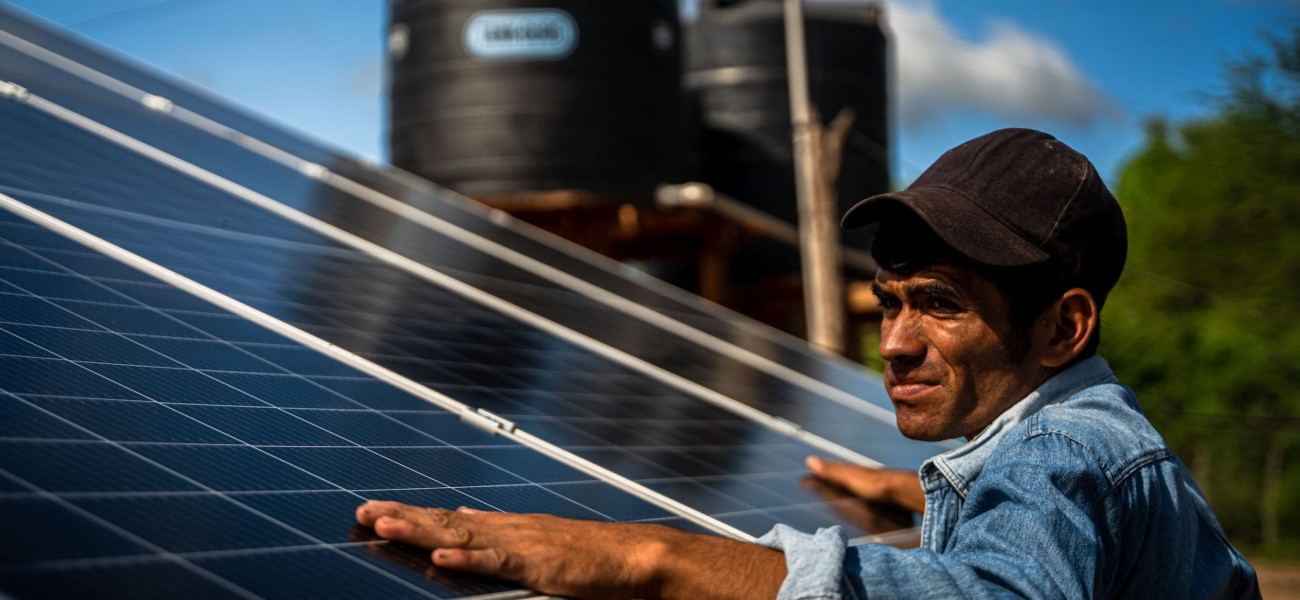
Technician inspecting a solar panel © UNDP Bolivia
Bolivia remains highly dependent on imported fossil fuels, particularly diesel and gasoline, to sustain mobility, logistics, and food production. As foreign currency constraints intensify, securing these imports has become increasingly complex, putting pressure on the balance of payments and highlighting the risks associated with prolonged dependence on fossil fuels.
In this context, accelerating the energy transition is no longer only a climate objective, but also an economic and strategic necessity.
In 2025, with support from UNDP’s Climate Promise under the Pledge to Impact program, Bolivia developed an energy sector roadmap as part of recent efforts to implement its Nationally Determined Contributions (NDCs). Developed through a broad and participatory process, the roadmap provides a clear and actionable path to diversify the energy mix, reduce structural vulnerabilities, strengthen energy security, and mobilize public and private investment.
Prepared in close coordination with the Ministry of Hydrocarbons and Energy, the Plurinational Authority of Mother Earth, and the Vice Ministry of Planning and Energy Development, the roadmap helps align Bolivia’s NDC climate commitments with national development strategies and sectoral priorities, ensuring coherence among climate ambition, energy planning, and economic goals. In addition, through the preparation of subnational energy balances, the roadmap reveals regional asymmetries in energy supply and demand, making it possible to strengthen evidence-based decision-making at the departmental and municipal levels and to link national climate goals with local development priorities.
Finally, the roadmap includes five key recommendations for advancing toward a sustainable energy future for Bolivia:
- Promote sustainable energy as a driver of development
- Promote regulatory reforms to unlock investment
- Reform fossil fuel subsidies for a fairer energy market
- Mobilize financing to turn ambition into tangible results
- Place energy security at the center of the energy transition
Through regulatory reforms, responsible subsidy management, and the mobilization of green financing, Bolivia has a unique opportunity to transform its energy sector, fulfill its climate commitments, and strengthen its energy security. To ensure implementation and accountability, the roadmap includes a monitoring framework to track progress over time.
By demonstrating concrete investments and tangible results on the ground, Bolivia will be able to position itself as an attractive destination for sustainable, climate-aligned investment and turn its clear, evidence-based, and consensus-built vision of a sustainable energy future into a reality.
Further reading:
Bolivia's Roadmap to a Sustainable Energy Future- Project:
- Contact:
Lorenzo Eguren